Bay Area, mobile, open 24 hours
Mobile semi trailer tire repair
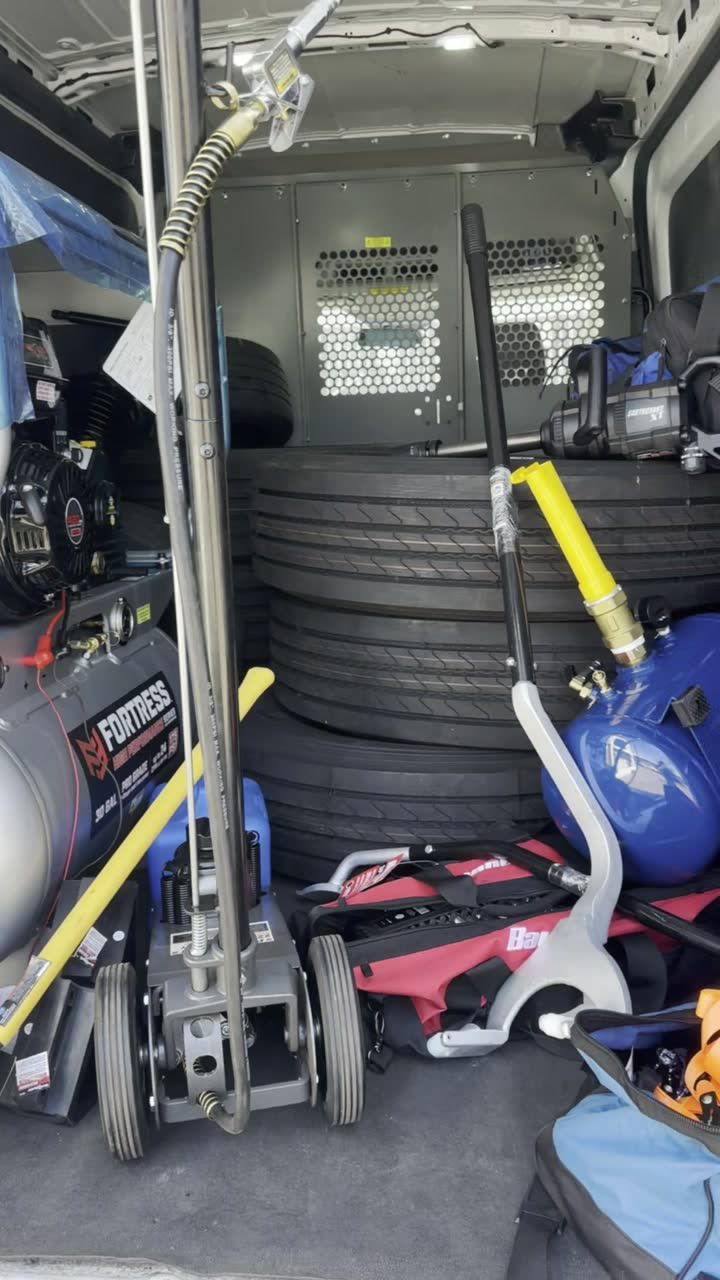
Dry van, reefer, flatbed, tanker, or chassis. On the shoulder or dropped in a yard, we load your size and the van comes to the trailer with the tire, the jack, and the compressor.
Semi trucks, truck tractors, commercial trailers, dump trucks, garbage trucks, and box trucks. Trailer positions, singles and duals. New and used tires in all common commercial truck and trailer sizes, loaded for each call.
Dry vans, reefers, flatbeds, tankers, chassis
Each one has its own catch. Tell us what you are pulling and we plan the lift before we leave.
Dry vans. Duals on a tandem. When one tire of a pair goes, the other has been carrying double. We check it before you roll.
Reefers. The unit keeps running. We work around it. If the load is on a clock, say so.
Flatbeds. Spread axles scrub tires in tight turns, so shoulder wear shows early. We lift one axle at a time with the load strapped as it sits.
Tankers. Liquid shifts when one corner comes up. We chock, lift slowly, and lift only as far as the tire needs. A loaded tanker on a soft shoulder may need to move a few feet first.
Container chassis. Bare or under a box, at a depot or dropped in a pool. Give us the chassis number and the yard and we find it. While we are under it, we look at the rest of the set.
Trailer tire blowout on the highway
It goes with a bang and a pull. The tractor still steers. Do this, in this order.
- Keep rolling to a wide shoulder. If the trailer will roll, do not stop where you are. A shredded tire is a tire. A trailer stopped a foot from the lane is a bigger problem. Aim for a wide shoulder, an off-ramp, a weigh station, or a lot.
- Hazards on, triangles out. On a divided highway, 10, 100, and 200 feet behind the trailer, toward approaching traffic, within ten minutes of stopping.
- Get behind the barrier. Climb out on the side away from traffic. Stand behind the guardrail or well off the shoulder, never between the trailer and the lane.
- Call us. Highway, direction, last exit or mile marker, which tire, the size on the sidewall, loaded or empty.
If the tire took an air line, a mud flap, or a light with it, say so. We do tires. If the trailer needs more than a tire before it can move, we tell you before the van rolls, so you can decide about a tow.
Duals on a trailer axle
Outside tire flat: it comes off and we check the inside before the pair goes back together. Inside tire flat: both come off. A blown inside dual usually chews the sidewall of its mate, and a tire that carried double for twenty miles has been cooked. Better to find that in the yard than on the grade.
Duals get matched. A new tire next to a worn one runs hotter and wears faster. We measure both, tell you the difference, and you decide. Lug nuts go on with a torque wrench, not a guess.
Lifting a loaded trailer
A loaded tandem can carry 34,000 pounds. We lift one axle end at a time: jack under the axle on a solid pad, stands in before a wheel comes off, chocks on the wheels that stay down. On a soft shoulder or a slope we crib the jack or ask you to move a few feet.
If it cannot be lifted safely where it sits, we say so. A loaded trailer coming off a jack is the one thing we will not risk.
Dropped trailers, yards, and the Port of Oakland
A lot of trailer tire work happens with no tractor attached and nobody next to the unit. The call needs a little more detail.
- The yard address and a gate contact. Someone who knows we are coming and can let us in.
- The trailer or chassis number and roughly where it sits. Row and slot if the yard has them.
- Which tire and the size on the sidewall. A photo by text saves a second trip.
- Loaded or empty, and whether the unit can be moved.
At the Port of Oakland, tell us whether the chassis sits inside a marine terminal or at an off-dock yard, because check-in is different. We need the yard, the gate, the chassis number, and a contact who can confirm we are expected. Same for the yards and terminals around San Jose, Santa Clara, Sunnyvale, and Milpitas.
What a yard call looks like
- You call or text with the yard, the unit number, the tire, and the size. We load your size before we roll and give you a window. A dropped trailer is not going anywhere, so if you would rather set a time, say so.
- We check in at the gate with your contact, find the unit, and chock it.
- Lift, pull the wheel, mount the tire, torque the nuts, set the pressure, check the mate.
- You hear from us when it is done. Nothing gets added at the end.
What the wear is telling you
Trailer tires get looked at less than any tire on the rig. Run a hand across the tread at your next stop. Here is what the patterns usually mean, and what we can and cannot fix.
Feathering. A sawtooth across the tread, smooth one way and sharp the other under your palm. The axle is not tracking straight: toe is off, or the axle is bent or out of square with the frame. A new tire will feather the same way. That is an alignment job at a trailer shop, and alignment is not something we do.
One-sided wear. The inside or outside shoulder worn down while the rest looks fine. Usually camber or an axle out of alignment. Sometimes a bearing on its way out or a bent spindle. A hub that is hot after a run, or grease slung on the inside of the wheel, points that way. We will say so. Bearings are trailer-shop work too.
Cupping. Scalloped dips around the tread. Loose or worn bearings, or a tire out of balance. Same answer: we tell you, you take it in.
Flat spots. One bald patch. The brake locked or dragged on that wheel. The tire may be finished, and the brake is a separate problem for a brake shop.
Even wear, low tread. That one is ours. The federal minimum on a trailer position is 2/32 of an inch in a major groove. We replace it in the yard on your schedule instead of on the scale's.
We do tires. We do not do alignment, bearings, brakes, or suspension. When the tire says the problem is one of those, we tell you straight and you decide where it goes next.
Sizes we load
New and used tires in all common commercial truck and trailer sizes, kept at the yard. Read the size off the sidewall, something like 295/75R22.5 or 11R22.5, and tell us when you call. We load your size before we roll.
Trailer tire questions
Can you change a trailer tire with the trailer loaded?
Yes. We lift one axle end at a time with stands in and chocks on the wheels that stay down. On a soft shoulder or a slope we may ask you to move a few feet first. If it cannot be lifted safely where it sits, we say so before we start.
Do I need a tractor hooked to the trailer?
No. Dropped trailers and chassis are routine. Give us the yard address, a gate contact, the unit number, and roughly where it sits.
Can a trailer tire be repaired, or does it need replacing?
A puncture in the tread on a sound casing can usually be repaired from the inside. Sidewall damage, a blowout, a separated tread, or a tire that ran flat for any distance means replacement. We tell you which before we start and show you why.
What trailer tire sizes do you carry?
We keep new and used tires in all common commercial truck and trailer sizes at the yard and load your size before we roll. Tell us the size on the sidewall when you call.
My trailer tires are wearing on one side. Can you fix that?
We replace the tire and tell you what the wear points to. One-sided wear or feathering means the axle is not tracking straight, or a bearing is going. Alignment, bearings, and brakes are trailer-shop work, and we do not do them. A new tire on the same axle wears the same way.
What should I do first after a trailer tire blowout on the highway?
If the trailer will roll, get to a wide shoulder, an off-ramp, or a lot. Hazards on, triangles at 10, 100, and 200 feet behind you. Get behind the barrier, away from traffic. Then call with the highway, direction, last exit, which tire, and the size.
What do you need for a chassis at the Port of Oakland?
The terminal or yard, the gate, the chassis number, and a contact who can confirm we are expected. Say whether it is inside a marine terminal or at an off-dock yard, because check-in is different, and whether it is bare or under a box.
Trailer down now?
Dropped trailer, no rush? Text us with where the truck is and the tire size, and we call you back.